
About wild harvest
Products sourced from naturally grown plants in the wild are eligible for organic certification under established standards. However, it is imperative for operators to safeguard the integrity of the collection process, ensuring both product traceability and compliance with collection standards. Key factors such as delineating defined collection areas, securing permission from relevant authorities for wild harvesting, and implementing comprehensive collection management plans are crucial for meeting certification requirements.
The meticulous attention to these essential points not only ensures the authenticity of wild-harvested products but also underscores the commitment to sustainable practices. By adhering to these standards, operators uphold the integrity of organic certifications and contribute to the preservation of natural ecosystems while providing consumers with confidence in the organic products they choose.


document
The purpose of this list is to make the operator aware about the certification requirements and documentation. The documents mentioned in the list given below shall be maintained by the operator and be submitted to the Certification Body at the time of inspection.
- Company registration
- Organization chart
- List of approved collectors with details
- Internal collection standards/regulations
- Forest permission letter
- Study of prohibited/restricted/reserved forest by forest department
- Declaration regarding endangered species by forest department
- Proof of study of application of prohibited substances
- Proof of sustainability studies
- Collection management plan
- Collection area map
- Collectors’ training schedule
- Collectors’ training record
- Traceability system
- Product wise collection records
- Plan & sketches of storages
- Sales record
- Subcontract (if any)
- Label draft(s)
- Complaint register
- Details of processing activity (if any)
Procedure
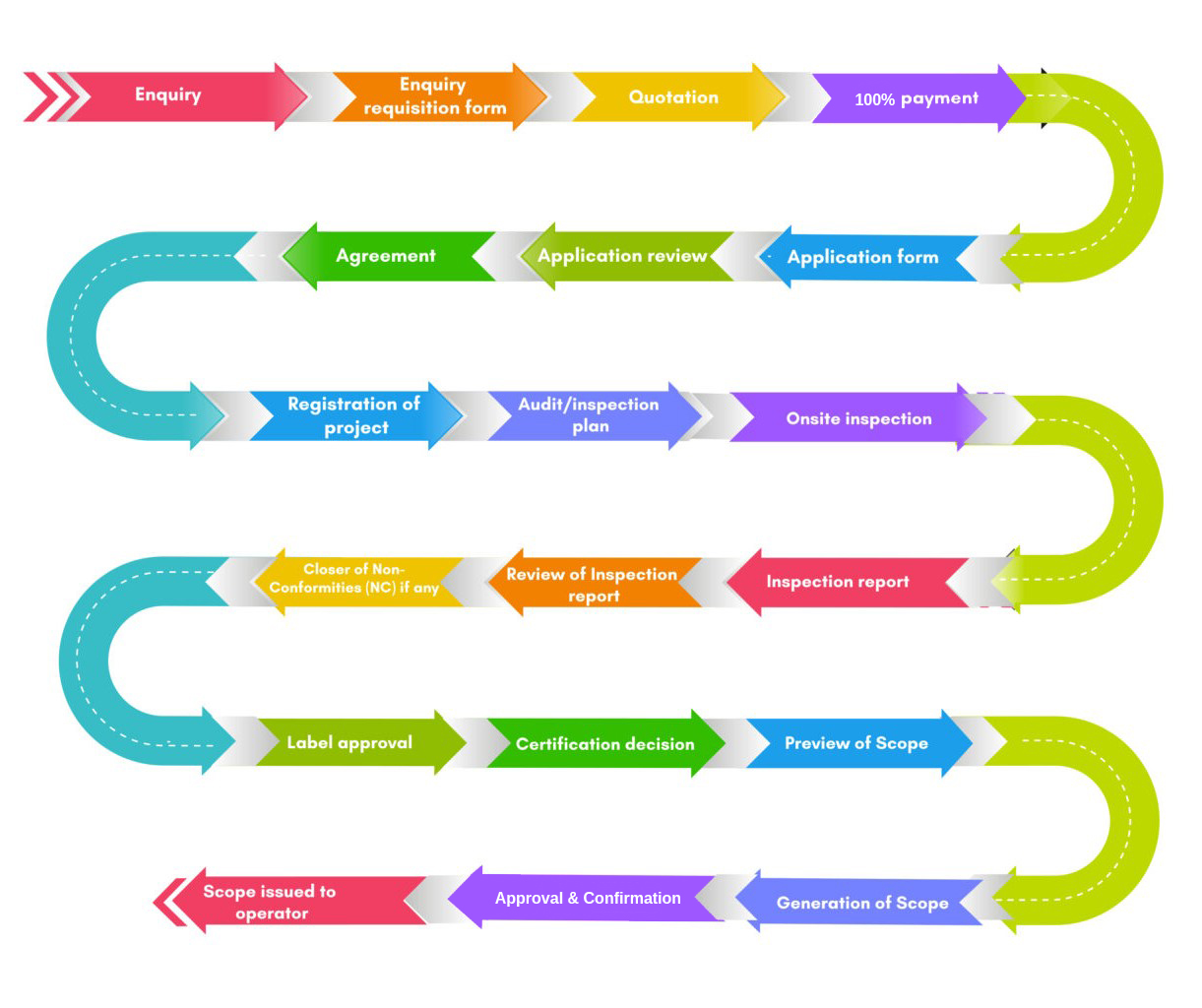
- Make an enquiry: This initial step involves a potential customer expressing interest in a product or service, seeking details about specifics, pricing, and availability.
- Fill out the enquiry requisition form: The customer provides essential information via a form, allowing the company to understand their requirements.
- Receive a quotation: The company prepares a detailed quotation based on the enquiry, outlining the cost, terms, and conditions.
- Make a 100% payment: Once the customer approves the quotation, they proceed by making an initial payment, usually equaling 100% of the total amount, to advance with the transaction.
- Enter into an agreement: The customer and the company formalize their commitment through a contract, service agreement, or another legally binding document.
- Application review: The company reviews the customer's application or request to ensure it aligns with their policies and requirements.
- Fill out the application form: The customer provides additional details required for processing.
- Register the project: The company officially registers the project, assigning it a unique identifier.
- Create an audit/inspection plan: A plan is developed to assess the project's compliance, quality, and safety.
- Conduct on-site inspection: Experts visit the project site to verify its status and adherence to standards.
- Clearances and formalities at NIC (National Inspection Council): Obtain any necessary approvals or clearances from relevant authorities.
- Review the inspection report: Document the findings from the on-site inspection in a detailed report.
- Receive the inspection report: The customer receives the report, which may include recommendations or corrective actions.
- Obtain label approval: If applicable, the project receives certification labels or marks.
- Make a certification decision: Based on the inspection report and other factors, the company decides whether to grant certification.
- Preview the scope: The customer is informed about the scope of certification and any limitations.
- Issue scope to the operator: The certified scope is officially provided to the project operator or owner.
- Approval and Confirmation: The Project Operator or the Managing Director ensures it meets all requirements and expectations.
- Generate the scope: The necessary documentation related to the certified scope is prepared.
Get in touch
Ready to take the next step towards organic certification? Reach out to our expert team today for personalized guidance and support. Let's work together to cultivate a greener tomorrow.