
About input production
We specialize in endorsing products such as organic fertilizers/bio-fertilizers, bio-pesticides, and other organic plant protection materials in accordance with NPOP standards. Our aim is to inform operators about the certification prerequisites and necessary documentation. The list provided below outlines the documents that operators must maintain and submit to the Certification Body during inspections.
This guide serves as a comprehensive tool for ensuring adherence to regulations and facilitating the certification process. By following these guidelines meticulously, operators can showcase their dedication to organic principles and play a vital role in upholding the integrity of the certification system.
Demonstrating strict compliance not only validates the organic authenticity of products but also fosters trust among consumers. Through this commitment, operators actively contribute to the sustainability of agriculture and the promotion of eco-friendly practices, thus reinforcing the credibility of organic certifications in the market.


document
The purpose of this list is to make the operator aware about the certification requirements and documentation. The documents mentioned in the list given below shall be maintained by the operator and be submitted to the Certification Body at the time of inspection.
- Company registration
- Organization chart
- Application & CV’s of the staff
- Appointment orders of the staff
- Conflict of Interest & Confidentiality
- Annual training schedule of staff
- Staff Training record
- Subcontract if any
- Letter from Pollution Control Board
- SOPs for all products
- Publicity material
- Cleaning schedule
- Sketch/ layout of processing unit
- List of machineries with capacity
- List of equipments
- Machine log book
- Raw material purchase record
- Inward register
- Processing record
- Sales record
- Outward register
- Product balance table
- Complaints register
- Input guarantee
- List of ingredients/food additives used
- Non GMO declaration for purchased inputs
- List & type of packaging material
- Proof of sustainability study and study of environmental effects
- Cleaning register
- Label drafts
- Samples of packing material
Procedure
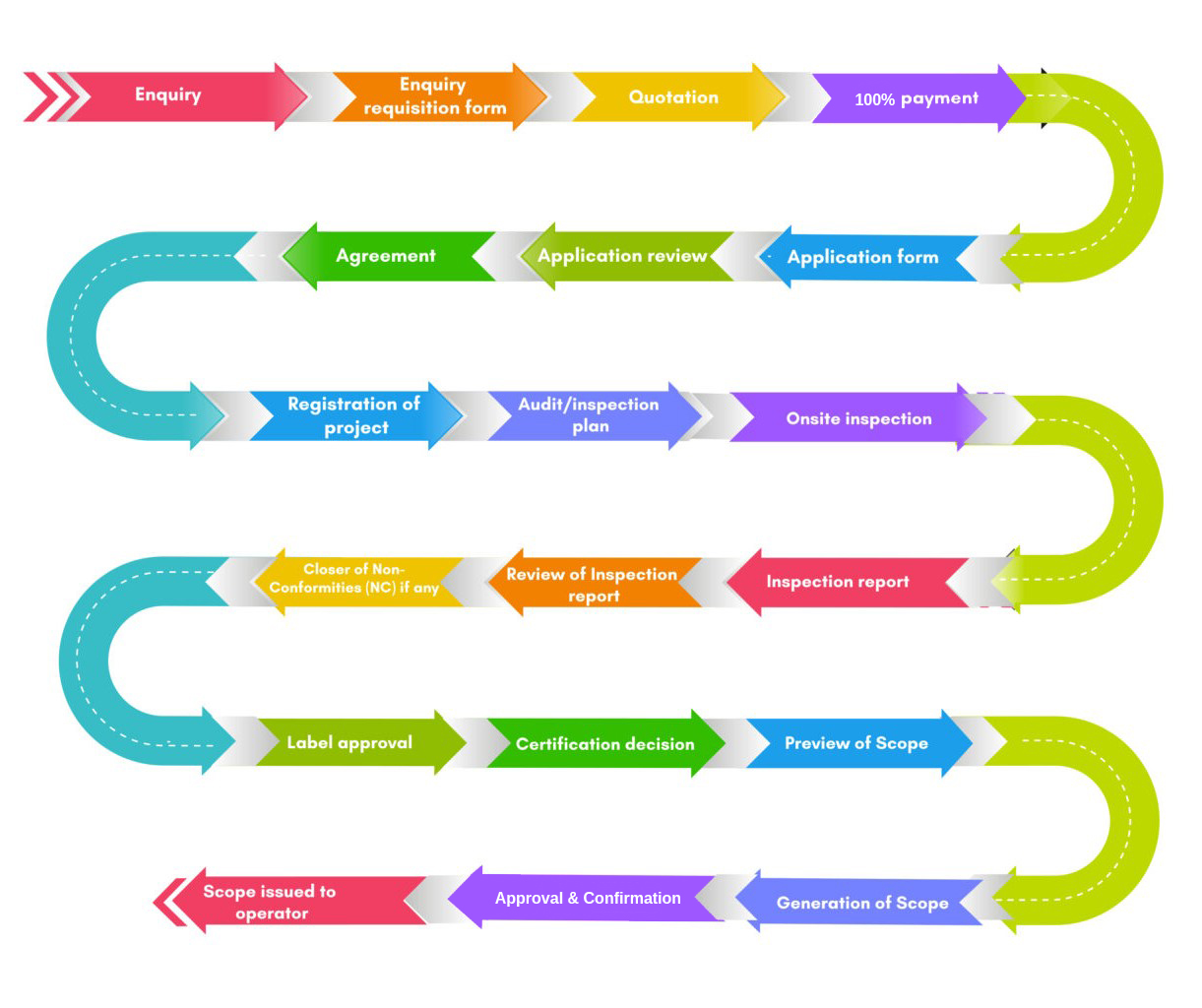
- Make an enquiry: This initial step involves a potential customer expressing interest in a product or service, seeking details about specifics, pricing, and availability.
- Fill out the enquiry requisition form: The customer provides essential information via a form, allowing the company to understand their requirements.
- Receive a quotation: The company prepares a detailed quotation based on the enquiry, outlining the cost, terms, and conditions.
- Make a 100% payment: Once the customer approves the quotation, they proceed by making an initial payment, usually equaling 100% of the total amount, to advance with the transaction.
- Enter into an agreement: The customer and the company formalize their commitment through a contract, service agreement, or another legally binding document.
- Application review: The company reviews the customer's application or request to ensure it aligns with their policies and requirements.
- Fill out the application form: The customer provides additional details required for processing.
- Register the project: The company officially registers the project, assigning it a unique identifier.
- Create an audit/inspection plan: A plan is developed to assess the project's compliance, quality, and safety.
- Conduct on-site inspection: Experts visit the project site to verify its status and adherence to standards.
- Clearances and formalities at NIC (National Inspection Council): Obtain any necessary approvals or clearances from relevant authorities.
- Review the inspection report: Document the findings from the on-site inspection in a detailed report.
- Receive the inspection report: The customer receives the report, which may include recommendations or corrective actions.
- Obtain label approval: If applicable, the project receives certification labels or marks.
- Make a certification decision: Based on the inspection report and other factors, the company decides whether to grant certification.
- Preview the scope: The customer is informed about the scope of certification and any limitations.
- Issue scope to the operator: The certified scope is officially provided to the project operator or owner.
- Approval and Confirmation: The Project Operator or the Managing Director ensures it meets all requirements and expectations.
- Generate the scope: The necessary documentation related to the certified scope is prepared.
Get in touch
Ready to take the next step towards organic certification? Reach out to our expert team today for personalized guidance and support. Let's work together to cultivate a greener tomorrow.